
The Thinking Hand, Retooled
How the tactile knowledge of making is being eroded and reinvented in an age of parametric design and AI.

The Hand That Thinks
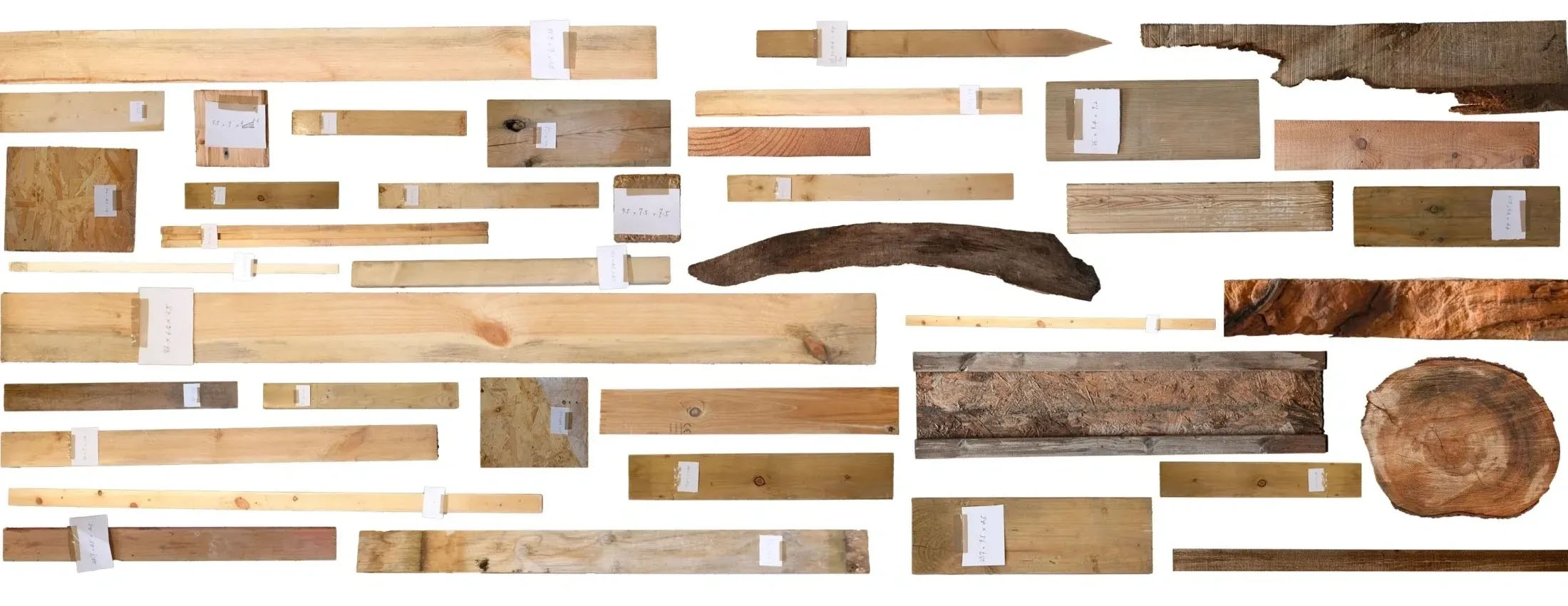
The first material I ever truly understood, I understood through my hands before my eyes caught up. It was 2020, and I was working with off-cut timber, the short, awkward ends that fall away from every cut and are usually swept into a skip. I had collected them by the crateful, and for weeks my work was simply to know them: to sort each piece by its section, to feel where a length had warped, to turn a block until its grain agreed with what I wanted to make. No two off-cuts were alike. A saw met one differently than the next; a joint that held in oak slipped in pine. This was not yet design in any drawn sense. It was a slower kind of thinking that happened in the fingers, a judgement about resistance, weight, and fit that I could not have arrived at by looking at a photograph of the same pile.
Juhani Pallasmaa gave this experience a name. In The Thinking Hand, he argues that the hand is not a mere instrument carrying out orders from the mind, but a partner in thought itself: that in touching, shaping, and joining, we are already reasoning. His wider work is a sustained protest against the dominance of the eye, against a culture of design that has come to privilege the image over the grip, the rendered surface over the worked one. Knowledge of this kind lives in the hand, not on the screen. It is tacit, accumulated through doing, and largely impossible to transmit as a diagram. Anyone who has learned a craft knows the feeling of understanding something with their body some time before they can explain it.
And then, in the same project, I took that knowledge away from my hands. To make the off-cuts computable, I 3D-scanned them, each irregular block became a clean mesh, then a voxel, then a row in a database. A Wave Function Collapse algorithm shuffled those voxels into aggregations far larger and stranger than anything I could have felt my way toward: walls, a chair, the beginnings of a pavilion, assembled in the model and only later in the world. The gain was real. I could explore combinations at a speed and scale no amount of patient handling would allow. But something quiet was lost in the translation. The warp that made one piece stubborn, the grain that made another beautiful, the small accidents that a maker learns to work with rather than against, all of it flattened into a uniform unit the algorithm could treat as interchangeable. The material had become information, and information does not resist you.
I do not tell this against myself as a confession, and certainly not out of nostalgia. I still work this way; I would not give up the reach the algorithm gave me. Most of us who design now live on both sides of that translation, moving between the timber and the scan many times a day without noticing the seam. That is precisely why it deserves attention. Digital practice has not so much abolished the thinking hand as quietly relocated it, from the workbench to the screen, from the grip to the click, and it has done so with such convenience that the loss is easy to miss.
But relocation is not the same as disappearance. The hand has not been removed from making; it has been retooled. Its knowledge is being redistributed into new places, into haptic devices that simulate touch, robotic arms that inherit a gesture, tool-paths that encode a craft, materials engineered to answer back. The more interesting question, and the one this essay pursues, is not whether the thinking hand survives the age of intelligence, but where it now resides. It is also the collision that the Reality Intelligence Association's Mind × Body archive sets out to gather and display: the precise, often fleeting instant where thought and touch provoke one another into a form neither could reach alone.
A New Anatomy of the Hand
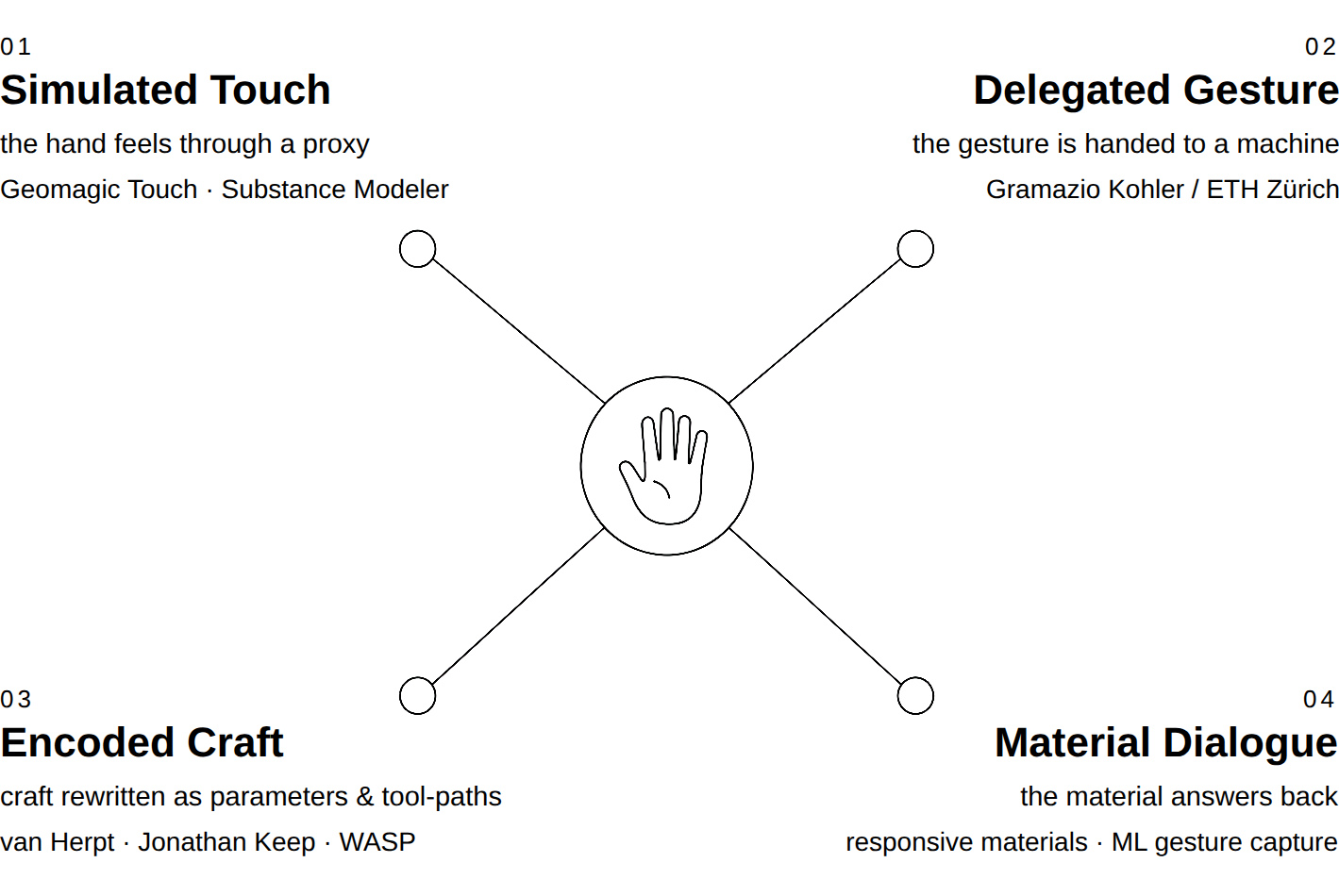
When I try to locate the hand inside making today, it does not sit in one place. It splits. What follows is a highly biased map, not a taxonomy I would defend as complete, but a working anatomy that helps me see where the tacit knowledge of the hand has gone. It divides into four modes, and each is a different answer to the same question: if the thinking hand no longer lives only at the workbench, where does it now reside? The first mode simulates touch; the second delegates gesture; the third encodes craft; the fourth opens a dialogue with the material itself. They overlap in practice, but it is worth taking them one at a time.
Simulated Touch. In the first mode, the hand still feels, but through a proxy. Haptic interfaces return force to the fingers so that a maker can shape a material that is not there. Devices in the lineage of SensAble's PHANTOM, now sold as the Geomagic Touch, let you push a stylus into a virtual mass and feel it push back; in virtual reality, tools such as Adobe's Substance Modeler, which grew out of Oculus Medium, let you knead and carve digital clay with both hands in the air. The promise is seductive: all the responsiveness of modelling by hand, with none of the mess, the cost, or the irreversibility. But the touch these systems return is a calculated approximation, a resistance the software decides to grant. The material does not have its own grain, its own bad days. It resists only in the ways it has been told to. This is the hand at its most preserved and its most abstracted at once, and the essay will return to what that trade costs.
Delegated Gesture. In the second mode, the hand withdraws and the gesture is handed to a machine. Robotic fabrication takes the movement a maker once performed, the sweep of laying material, the pressure of a joint, and transfers it to an arm that can repeat it with a scale and consistency no body could sustain. The research of Gramazio Kohler at ETH Zürich has spent more than a decade turning bricklaying, timber assembly, and clay extrusion into choreographed robotic routines; a robot lays down a coil of clay, and the throwing motion survives as a programmed path. What is retained here is the intention, the designer still decides what the gesture should be. What is delegated is the doing. The interesting residue is that the machine does not tire, does not improvise, and does not feel the moment when a material tells the maker to stop. The judgement stays human; the touch does not.
Encoded Craft. In the third mode, the tacit rules of a craft are rewritten as parameters and tool-paths. Here the knowledge that once lived silently in a potter's wrists is made explicit, turned into code, slicing logic, and the visible geometry of a print. In additive ceramics, makers such as Olivier van Herpt and Jonathan Keep have built printers that extrude clay layer by layer, and the ridged line of each layer becomes a signature as particular as a throwing line ever was; open machines like the WASP clay printers have put the same logic within reach of small studios. Encoding craft does not simply automate it. It forces the maker to state what was previously felt, to decide, in numbers, how thick, how fast, how high a wall of wet clay can rise before it slumps. Something is lost in being made explicit, and something is also revealed: a craft written down can be examined, shared, and argued with in ways an unspoken skill never could.
Material Dialogue. In the fourth mode, the loop between hand and material is re-mediated, and the material begins to answer back. This is the least settled of the four and the most speculative. Motion capture and machine learning can now record a craftsperson's movements and model them, so that a maker's tacit gestures become data a system can study or reproduce. Responsive and engineered materials, surfaces that change with heat, moisture, or load, turn the object from a finished thing into something that continues to behave after the hand has left it. When a material carries its own logic and a system can read the maker's hand in real time, the old one-way relationship, hand acts, material receives, becomes a conversation. And a conversation raises a harder question than any of the previous three: when the material and the machine both contribute, whose hand made the thing?
Set side by side, these four modes are less a sequence than a set of overlapping answers. A single project might simulate a form, delegate its fabrication, encode its craft, and leave the result to keep responding once installed. Together they suggest that the thinking hand has not been silenced so much as scattered, its knowledge redistributed across proxies, machines, parameters, and materials. The next section follows that knowledge into practice, to ask what each redistribution keeps, and what it quietly leaves behind.
The Hand in Practice
Seen from a distance, the four modes look like separate territories. Seen inside an actual project, they overlap and hand off to one another so quickly that the seams disappear. What follows is not a survey but a set of test cases, moments where I can point to a specific gesture, object, or tool and ask the only question that matters here: what survives the translation, and what is lost in it.
Begin with simulated touch, because it is the mode that feels most like making and is furthest from it. Sculpting in virtual reality with a tool like Substance Modeler is genuinely closer to working clay than any mouse-and-menu software ever was: you reach into the material with both hands, and with a haptic stylus you can even feel it resist. Form arrives quickly, and, crucially, it arrives reversibly. Nothing collapses; nothing dries before you are ready; a bad decision costs a keystroke rather than a day. But the resistance is a courtesy the software extends. Real clay pushes back with a will of its own: it slumps past a certain height, tears if worked too wet, records every hesitation of the hand. That recalcitrance is not an obstacle to the thinking hand, it is the very thing the hand thinks with. Strip it out and you keep the shape of making while losing its argument. What simulated touch preserves is fluency; what it removes is consequence.
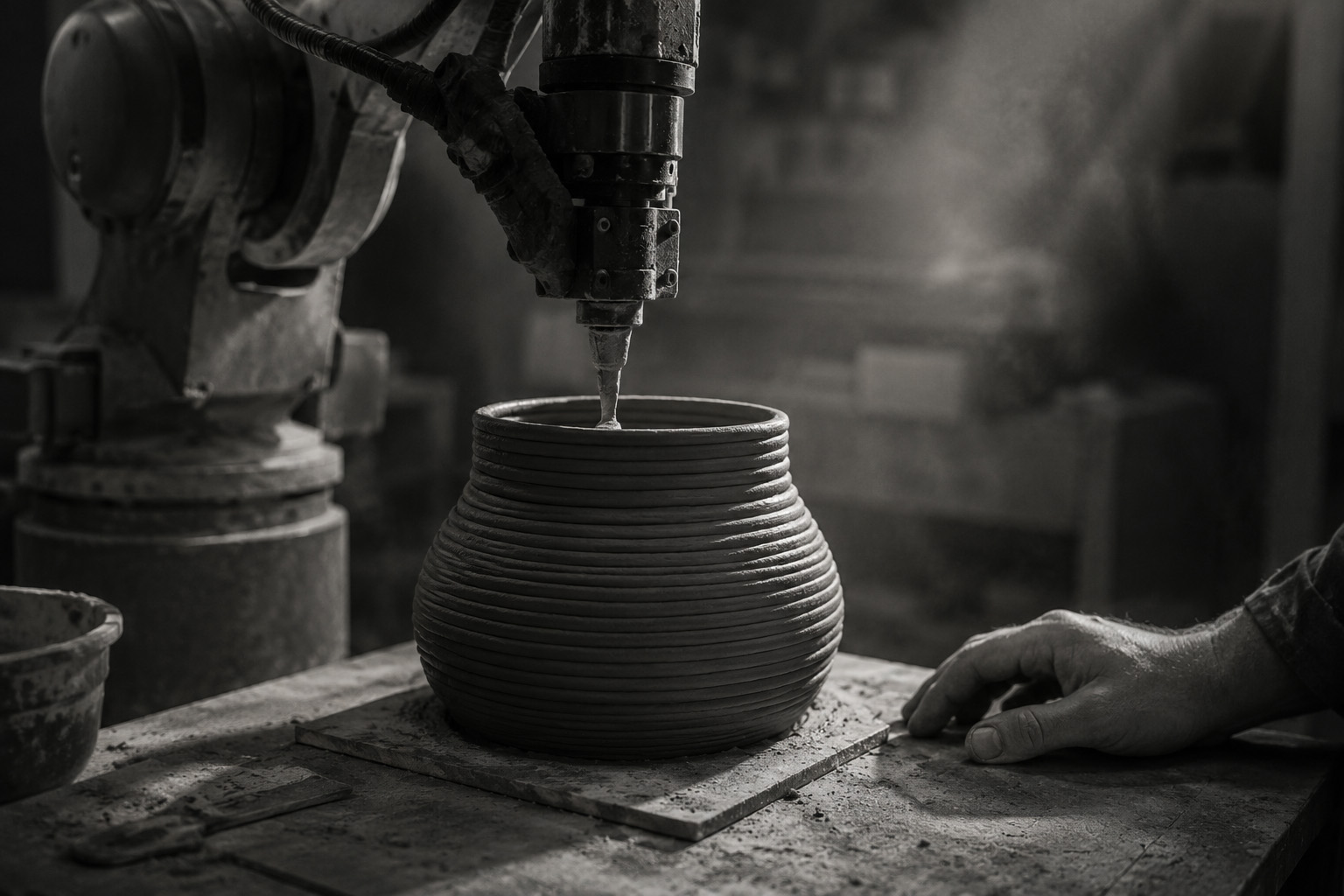
Delegated gesture and encoded craft are easiest to understand together, because a single object often carries both. Watch a robotic arm extrude a ceramic vessel and you are seeing a gesture that was once a potter’s, the steady rising coil, surviving as a programmed tool-path. The intention is still human: someone decided the profile, the rhythm, the wall thickness. But the doing has been delegated to a machine that will not tire on the hundredth piece, and the craft has been encoded into numbers that must be stated in advance rather than felt in the moment. The result is strangely honest about its own making. In the printed ceramics of makers like Olivier van Herpt, the ridged line of each deposited layer is not hidden but celebrated, a new kind of throwing line, authored by code rather than wrist. Here the loss and the gain are the same fact seen twice: the object can no longer record the small improvisations of a hand reading the clay as it rises, but it can record, with perfect legibility, a decision made explicit. A craft that was once mute becomes a craft that can be read.
My own work with off-cut timber sat across the same seam without my naming it at the time. Scanning each block was a small act of encoding, turning a felt knowledge of grain and warp into a mesh a machine could read, and letting the Wave Function Collapse algorithm aggregate those blocks was a delegation of the very judgement I had spent weeks building in my hands. What I gained was reach: combinations, scales, and structures I could never have assembled by patient trial. What I had to consciously guard against was the algorithm's indifference, its willingness to treat a stubborn, beautiful, warped piece as interchangeable with any other. The interesting design work, I came to realise, was not in the aggregation but in the constraints I wrote to discipline it: the rules that carried some fragment of a maker's judgement back into a process that had none of its own.
That realisation is the shape of the whole section. Across every case, the modes describe a loop. A gesture becomes data; data drives a machine; the machine works a material; and the material returns as an object that a person must pick up, look at, and judge, before the loop begins again. The retooled hand is not a straight line from craft to automation but this circuit, running faster and at larger scale than any unaided hand could manage. And the circuit has one point that no tool in it can occupy: the moment of judgement where a maker decides that this is right and that is not. Every mode in this essay redistributes some part of the hand's work to a proxy. None of them redistributes that.
Knowledge in the Hand
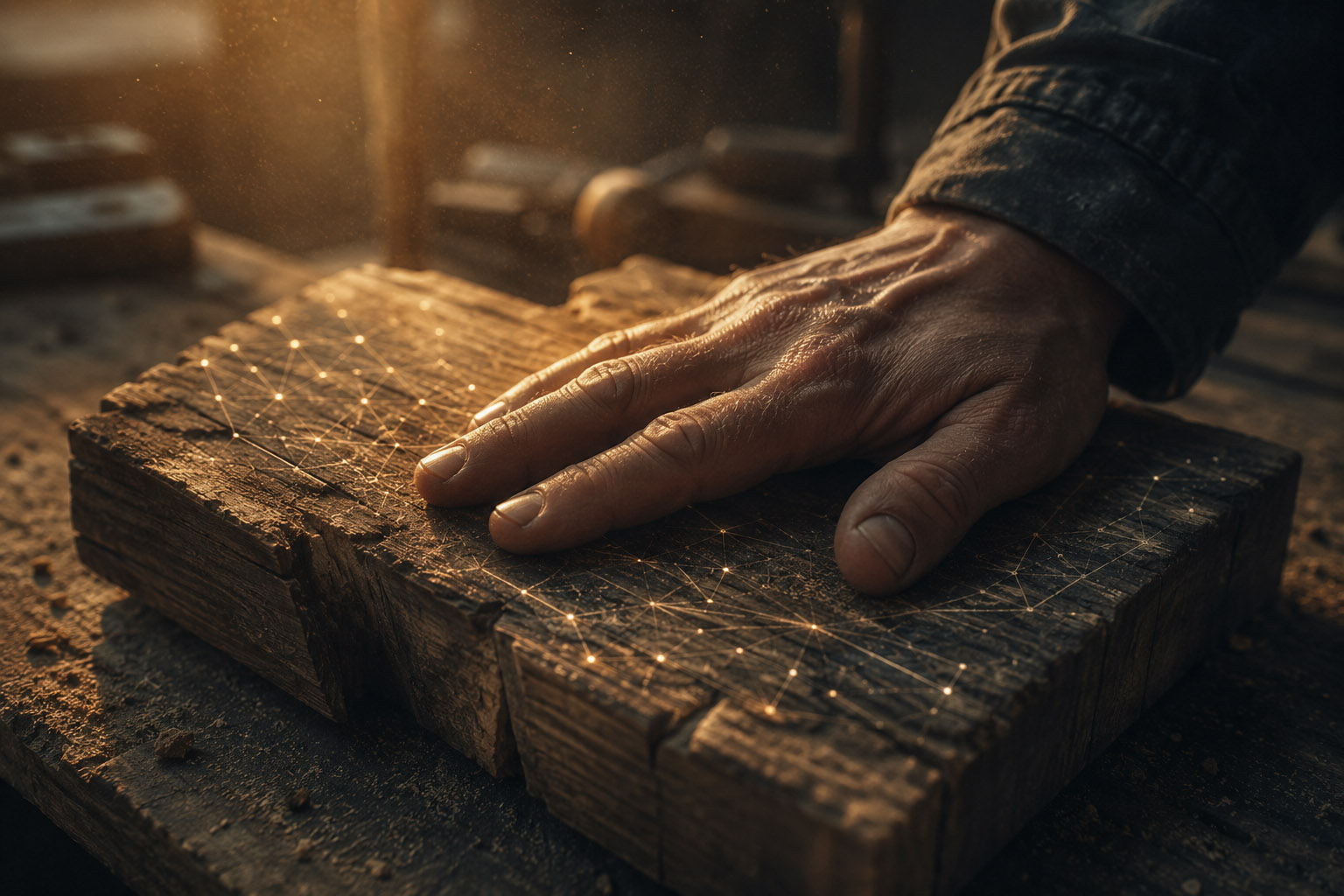
So where does this leave the thinking hand? Not obsolete, and not intact, retooled. Across all four modes, the hand's knowledge has been redistributed into proxies, machines, parameters, and materials, and in each case something genuine is carried across the translation. To retool the hand is not to remove it. The tacit intelligence Pallasmaa described can be extended into places a single body could never reach, provided one thing holds: that the maker's judgement stays at the centre of the loop rather than being quietly automated out of it. That proviso is the whole argument. Everything in this essay can be delegated except the moment of deciding that this is right.
The real risk, then, is not the one usually named. The anxious version of this story is that machines will replace makers, that the arm and the algorithm will do the hand's work and leave nothing for it. I think that fear is misdirected. The subtler and more likely danger is that we mistake simulation for substance: that we grow so fluent in materials that never resist us, forms that never fail, and processes that never surprise us, that we forget resistance and failure and surprise were where the hand did its thinking in the first place. A clay that cannot slump teaches you nothing about clay. A joint that always holds tells you nothing about the joint. The value of the recalcitrant material is precisely that it argues back, and a practice that engineers away all argument risks producing makers who are faster, more prolific, and slowly less wise.
But the opportunity is larger than the risk. A hand that can now think across scales and materials it could never physically touch, that can test a thousand aggregations of off-cut timber, or feel its way through a structure the size of a building, is not a diminished hand. It is an amplified one, so long as it stays a hand: so long as judgement, taste, and the willingness to reject the merely plausible remain human work. The architects and makers who will matter in this decade are not the ones who generate the most, but the ones who keep the sharpest sense of which of those generations is any good, and that sense is still built the old way, through years of touching real things. The retooled hand is at its best not when it replaces that education but when it puts it to work at a new scale.
This is why, at the Reality Intelligence Association, we treat the meeting of mind and body not as a problem to be solved but as a phenomenon to be studied. Mind × Body: Catalyst Phenomenon Archive gathers works that sit exactly on the seam this essay has traced, a pinched vessel that holds the ghost of a gesture, an unbuilt line that imagines how a body will move, a device that dissolves the boundary between skin and interface, not to declare whether the hand has won or lost, but to make the collision visible and hold it up for examination. Each is evidence that a reaction took place: that in some precise, fleeting instant, thought and touch provoked one another into a form neither could have reached alone. That instant is what we are after. In an age of intelligence, we study reality.
Views expressed in the Journal are those of the author and do not necessarily represent the position of the Reality Intelligence Association. Images courtesy of the author unless otherwise stated.
Back to the Journal